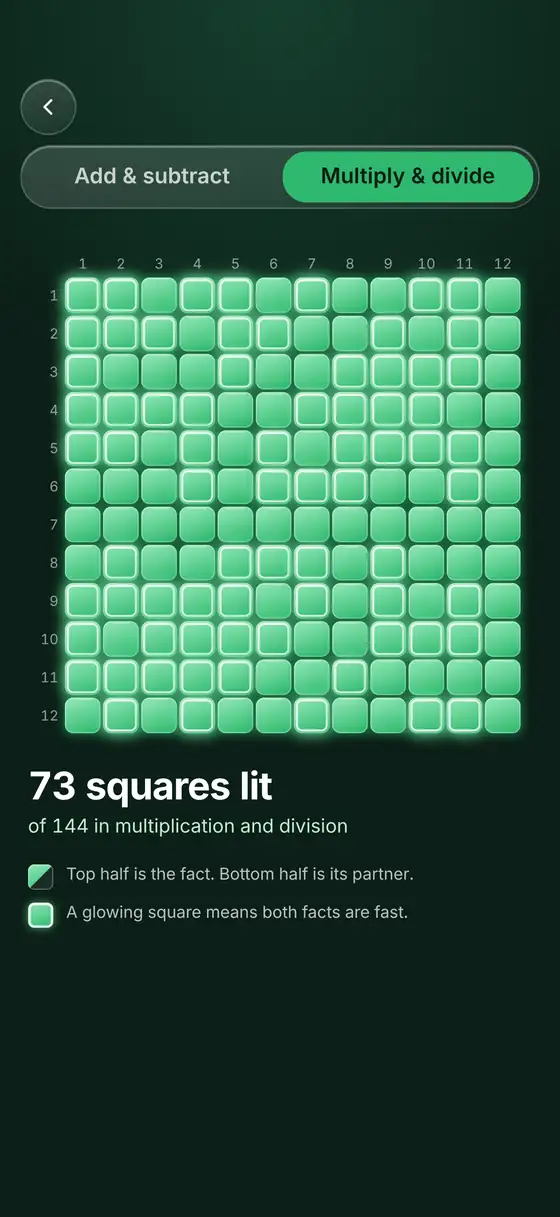
Then every fact gets fast.
Once a grid is full, practice turns to the slowest facts until every square glows.
Math facts for iPhone
One tap starts a 90-second round. The app picks every card from your child's answers.
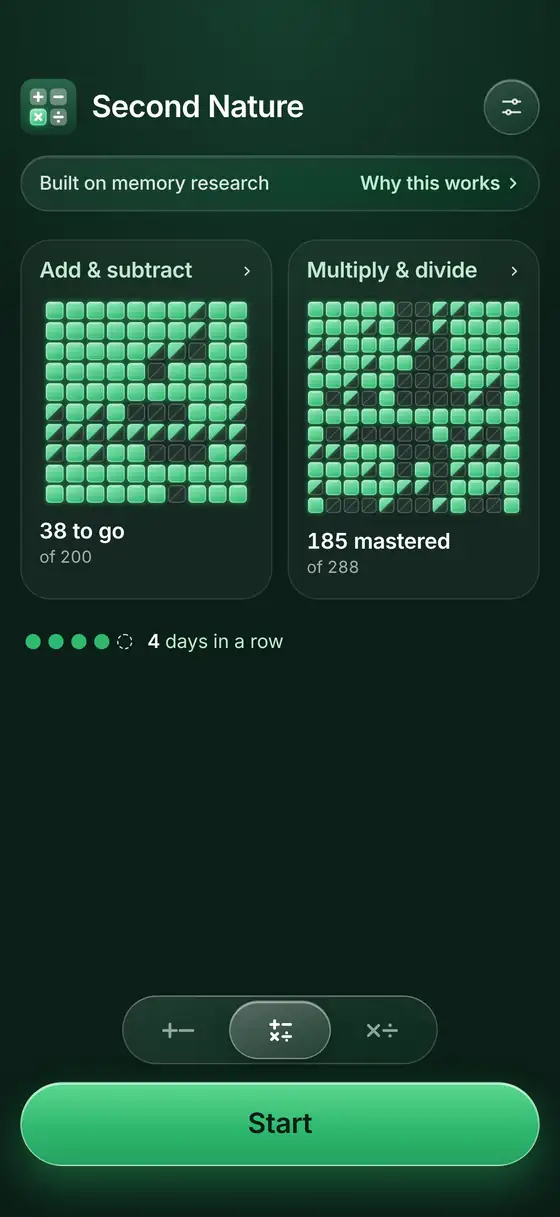
A fact counts only when it comes in under 3 seconds. That is fast enough to know it was remembered, not counted out.
Five cards.
Beat the bar.
Type each answer before the bar runs out.
Your keyboard works too.If your child keeps missing, new facts start with the answer shown. A moment later the answer is gone, and they type it from memory.
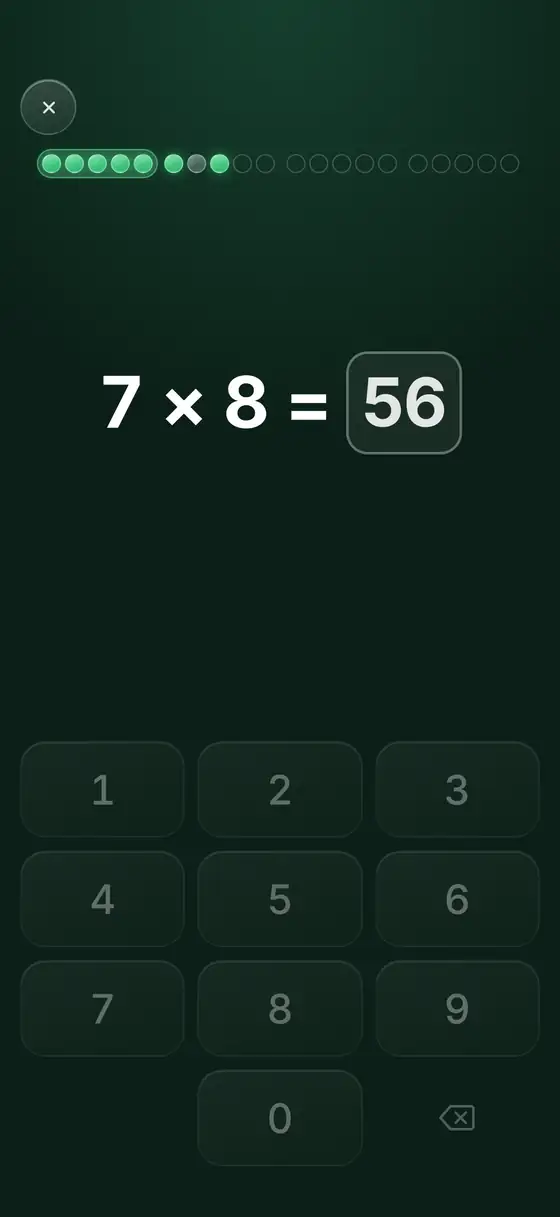
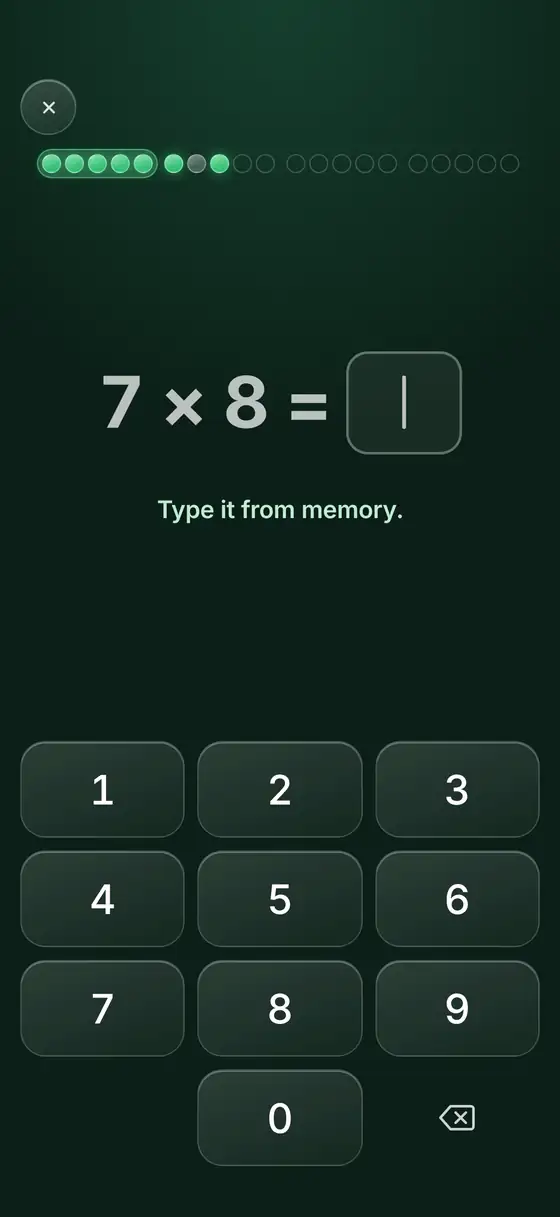
Right after a correct 7 × 8, the fact can turn into its partner. The 56 moves to the front, the sign flips, and your child finds the 7. Addition teaches subtraction the same way.
Paliwal, 2013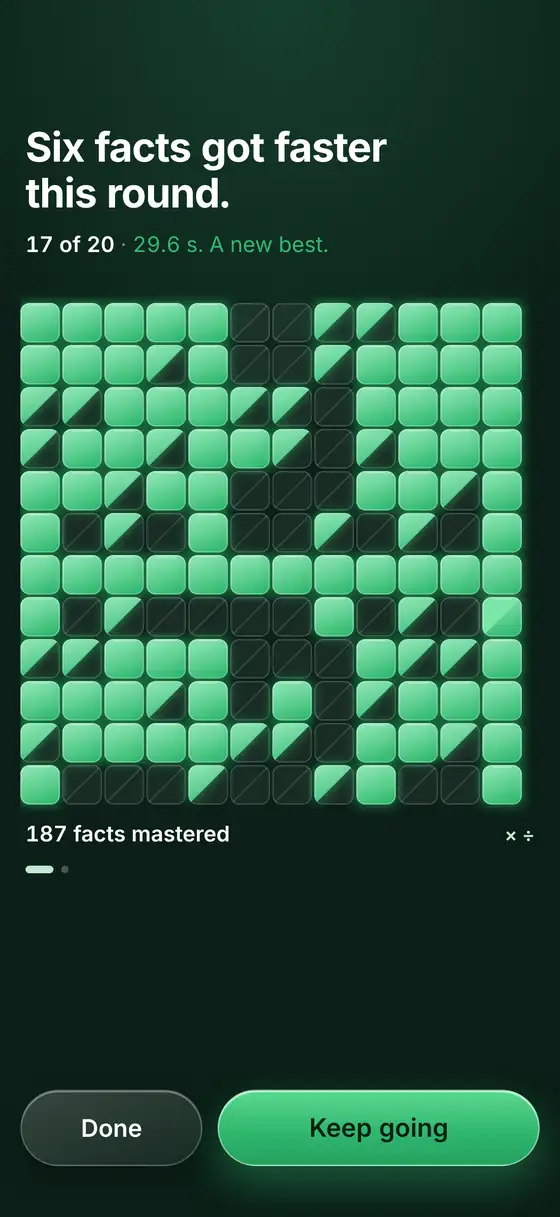
Each square holds a fact and its partner. A half fills when the answer comes in under 3 seconds, at least one round after the answer was last shown.
7 × 8 and 56 ÷ 8 are still in practice.
7 × 8 = 56 fills the top half.
56 ÷ 8 = 7 fills the bottom half.
Answer both quickly and the square glows.
Each rule in the app comes from a published finding.
Read the researchOnce a grid is full, practice turns to the slowest facts until every square glows.
Enough wins to keep going, enough misses to learn. The fastest learning came near 85% correct in a 2019 study.
Wilson et al., 2019Your child retypes it from memory, and it returns a few cards later. In one study, this step raised retention a week later by 494%.
Pashler et al., 2005Two rounds later, then after 3, 7 and 14 days. Recall spread over time lasts longer than recall packed into one sitting.
Karpicke & Roediger, 2007Review mixes every operation your child has started, so each card means reading the sign.
Rohrer et al., 2015Free to try. $7.99 unlocks every table for good. No subscription and no trial to cancel.
No ads, accounts, coins, characters or leaderboards. Prizes can undercut a child's own drive to learn, so the reward here is a grid that fills. Deci, Koestner & Ryan, 1999
An iPhone flash-card app for addition, subtraction, multiplication and division facts, for kids about 8 to 11. One tap starts a 20-card round that takes about 90 seconds. A fact counts when your child answers it in under 3 seconds.
The app picks every card from your child's answers. Of 20 cards, 3 to 7 work on new or shaky facts: more after a strong round, fewer after a weak one. New facts start easy and get harder as answers land, and no more than six are in progress at once. Every rule aims at about 17 of 20 right. It never asks your child's age.
You can choose the operations. A switch above Start picks addition and subtraction, multiplication and division, or all four. The app picks the cards.
Yes. Each rule comes from published memory research: the 3-second standard, showing the answer after a miss, spaced review, keeping practice near 85% correct, mixing operations and teaching subtraction and division from their partner facts. The research page lists the studies.
It teaches the answer, not a counting strategy. When misses pile up, new facts start with the answer shown, and your child types it from memory a moment later. A child who still counts on fingers for most facts needs strategy help first, from school or a parent. A fact that keeps timing out stays an empty half, so you can see where to help.
A half fills when the answer comes in under 3 seconds, at least one round after the answer was last shown. Filled facts come back for review. A fact that slips steps back and fills again once it's fast.
Speed becomes the goal. A square glows when both of its facts are fast, and practice turns to the slowest facts until every square glows.
It's free to try with the 1s, 2s, 5s and 10s in all four operations. One $7.99 purchase unlocks every table for good and covers your family through Family Sharing. There is no subscription.
An iPhone on iOS 26 or later. There is no sign-up and no setup. Rounds work offline; buying the unlock needs a connection.
Not yet. Version 1 tracks one learner per phone.
Nothing. There are no accounts, ads or analytics, and progress is stored only on the phone. See the privacy policy.

Built by a dad who wanted his daughter's facts to be second nature.
Coming soon to the App Store